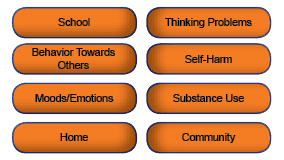
What is the CAFAS? The gold standard for assessing a youth's day-to-day functioning across critical life subscales AND for determining whether a youth's functioning improves over time.
....
Backed by over 20 years of research supporting its validity and sensitivity to detecting change in behaviors.
Widely used to inform decisions about level of care, type and intensity of treatment, placement, and need for referral
CAFAS items (problem behaviors, strengths, and goals) are behaviorally descriptive and anchored, resulting in high credibility
Quickly completed by practitioners (10 minutes), based on information from routine clinical evaluation
Designed for ages 5 to 19 (kindergarten and higher). For younger children please see information about the PECFAS.
The CAFAS is quickly completed by an assessor (10 minutes), based on information collected during a typical clinical assessment. The assessor “clicks” the behavior-based items that describe the youth’s functioning in each of the domains. For each domain (subscale), the assessor can also quickly identify the youth’s strengths and goals.
Results with interpretations are displayed instantaneously, and include: CAFAS scale scores, CAFAS Profile, alerts for critical items, risk behaviors, clinical markers, client types, and outcome indicators. The Client Assessment Report and the Family Report (which includes strengths and goals and shows progress) are generated entirely by the software. The assessor can add optional summary comments to appear on the Client Assessment report.
Based on the CAFAS items (i.e., target behaviors), and strengths and goals selected by the assessor, the software generates a Treatment Plan organized by subscales. The “action plan” section for each subscale is completed by the assessor.
After each assessment, a snapshot of the child's assessment results appear immediately on the Client Dashboard. If the CAFAS is re-administered to track progress (e.g., quarterly), outcome indicators focus attention to progress, or lack thereof.
The Supervisor Dashboard presents aggregated client data for subscale scores as well as a variety of clinical markers (e.g., risk behaviors, client types) and for outcome indicators (improving vs. not improving). It is easy to “drill down” to identify the specific youth who meet the criteria and then “click” to view the child's "Client Dashboard".
What is the CAFAS? The gold standard for assessing a youth's day-to-day functioning across critical life subscales AND for determining whether a youth's functioning improves over time.
....
Backed by over 20 years of research supporting its validity and sensitivity to detecting change in behaviors.
Widely used to inform decisions about level of care, type and intensity of treatment, placement, and need for referral
CAFAS items (problem behaviors, strengths, and goals) are behaviorally descriptive and anchored, resulting in high credibility
Quickly completed by practitioners (10 minutes), based on information from routine clinical evaluation
Designed for ages 5 to 19 (kindergarten and higher). For younger children please see information about the PECFAS.
The CAFAS is quickly completed by an assessor (10 minutes), based on information collected during a typical clinical assessment. The assessor “clicks” the behavior-based items that describe the youth’s functioning in each of the domains. For each domain (subscale), the assessor can also quickly identify the youth’s strengths and goals.
Results with interpretations are displayed instantaneously, and include: CAFAS scale scores, CAFAS Profile, alerts for critical items, risk behaviors, clinical markers, client types, and outcome indicators. The Client Assessment Report and the Family Report (which includes strengths and goals and shows progress) are generated entirely by the software. The assessor can add optional summary comments to appear on the Client Assessment report.
Based on the CAFAS items (i.e., target behaviors), and strengths and goals selected by the assessor, the software generates a Treatment Plan organized by subscales. The “action plan” section for each subscale is completed by the assessor.
After each assessment, a snapshot of the child's assessment results appear immediately on the Client Dashboard. If the CAFAS is re-administered to track progress (e.g., quarterly), outcome indicators focus attention to progress, or lack thereof.
The Supervisor Dashboard presents aggregated client data for subscale scores as well as a variety of clinical markers (e.g., risk behaviors, client types) and for outcome indicators (improving vs. not improving). It is easy to “drill down” to identify the specific youth who meet the criteria and then “click” to view the child's "Client Dashboard".